Latency Thresholds Affecting Strategic Choices in Unified Mobile Platforms Blending Reel-Based Entertainment, Person-to-Person Card Competitions, and Real-World Contest Predictions
Alex Lange · Nov 15, 2026

Latency Thresholds Affecting Strategic Choices in Unified Mobile Platforms Blending Reel-Based Entertainment, Person-to-Person Card Competitions, and Real-World Contest Predictions
Unified mobile platforms now merge reel-based games, peer-to-peer card tables, and live event predictions into single applications, and network latency directly shapes how participants time their actions across these modules, according to industry performance analyses released in late 2026.
Core Latency Metrics Across Game Types
Reel spins tolerate higher delays because outcomes generate server-side and display sequentially, yet card competitions demand sub-100 millisecond responses during betting rounds while real-world contest predictions require immediate updates to shifting odds lines. Data collected through November 2026 shows average mobile latencies in major markets ranging from 45 to 180 milliseconds depending on carrier infrastructure and device processing loads, with thresholds above 120 milliseconds prompting measurable shifts in user decision patterns. Observers note that players frequently switch from aggressive multi-table poker sessions to slower single-table formats once round-trip times exceed 110 milliseconds, a change documented in aggregated session logs from several large operators.
Strategic Adjustments in Card and Prediction Modules
Person-to-person card environments force participants to recalibrate bluff frequencies and pot-commitment levels when confirmation delays extend beyond 90 milliseconds, since opponents may interpret hesitation as weakness or strength. Real-world contest predictions add another layer because live odds refresh continuously, and a 150-millisecond lag can cause a predicted outcome to move from favorable to neutral before the wager registers. Researchers tracking behavior in combined sessions found that users reduce stake sizes by an average of 18 percent in prediction modules during periods of elevated latency, while maintaining original bet volumes in reel-based sections that process independently of real-time input. Those patterns emerge consistently in platform telemetry reviewed through the final quarter of 2026.
Platform Design Responses and Threshold Management
Application developers implement predictive caching and local decision queuing to keep effective latency below critical levels, yet these mitigations reach limits when underlying network conditions deteriorate. One study released by the American Gaming Association in October 2026 examined 12 integrated mobile titles and reported that interfaces displaying connection-quality indicators help users anticipate when to pause high-stakes card rounds or defer live prediction entries. Platforms that automatically route players toward asynchronous reel play during detected spikes above 130 milliseconds recorded higher session retention compared with those that maintained uniform pacing across all modules. The same report highlighted regional differences, with North American 5G networks maintaining sub-70 millisecond averages more consistently than certain Southeast Asian markets during peak evening hours.
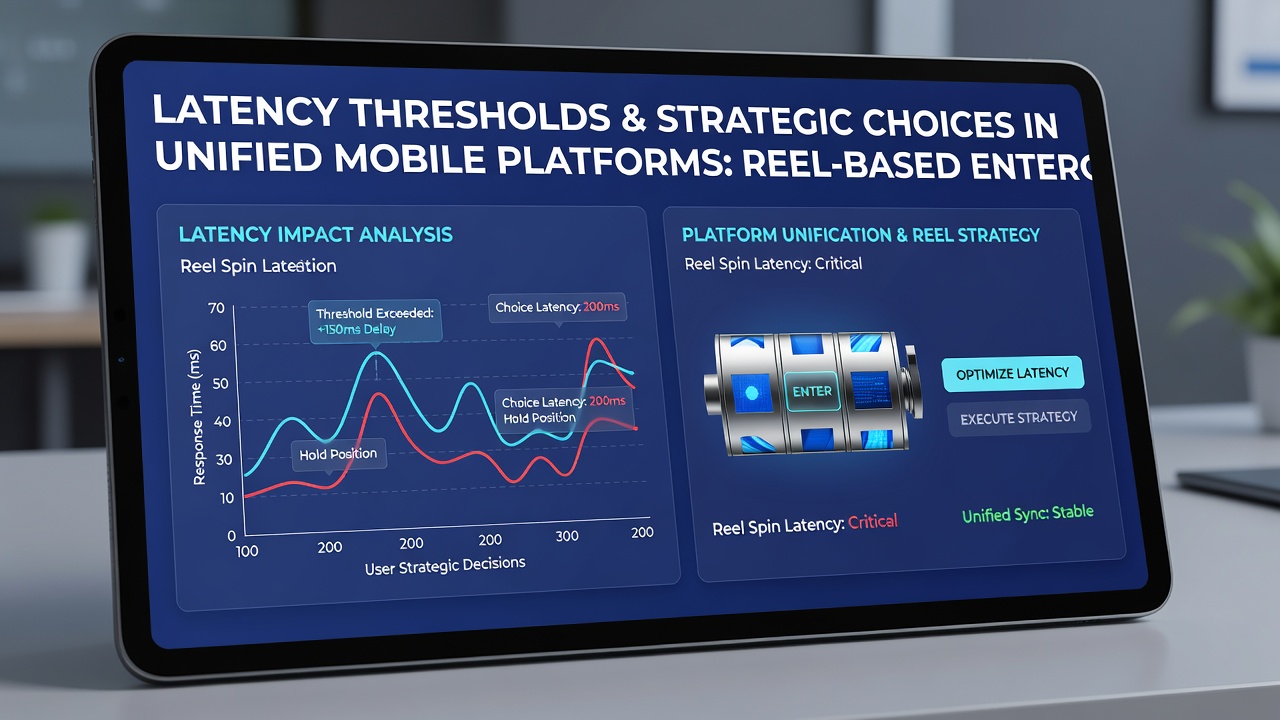
Additional safeguards include dynamic bet-size caps that activate once measured latency crosses predefined boundaries, a feature now present in several leading applications. Players receive on-screen prompts suggesting a move to lower-interaction reel sequences until conditions stabilize, and session data confirms these prompts correlate with reduced dispute rates around delayed actions. International Telecommunication Union guidelines on mobile application performance, updated in 2025, recommend exposing latency metrics directly in gaming interfaces so participants can make informed choices without leaving the platform.
Observed Patterns in November 2026 Data
Telemetry from major operators during November 2026 revealed that combined-platform users spent 27 percent more time in reel-based sections on days when average latency rose above 140 milliseconds, while card and prediction activity declined proportionally. The shift occurred across both casual and high-volume accounts, indicating a broad behavioral response rather than a narrow segment effect. Platform operators also recorded increased use of in-app toggles that allow manual selection of game modules based on current connection quality, a function introduced in several titles earlier that year.
Conclusion
Latency thresholds continue to influence how participants allocate attention and capital across integrated mobile environments that combine reel entertainment, card competitions, and contest predictions. As networks evolve and applications refine their adaptive features, the relationship between measured delay and strategic selection remains a central factor in platform design and user behavior tracking.